How Storm water Runoff Can Lead to Water Damage in Your Home
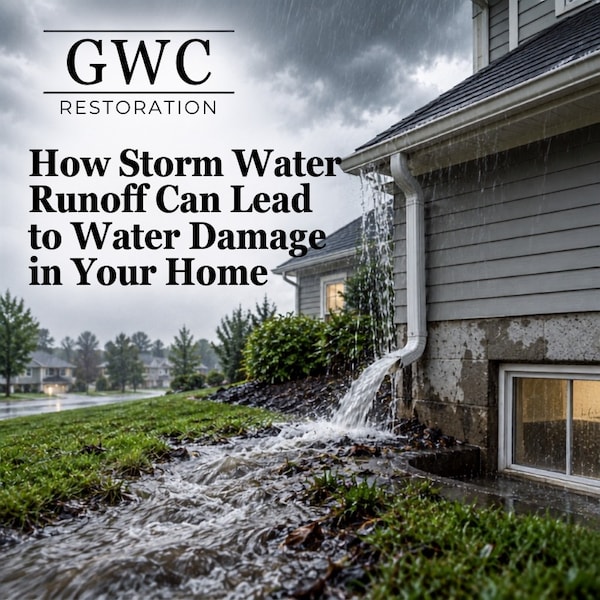
Quick answer: Storm water runoff causes home damage by overwhelming the soil, gutters, and grading around your foundation faster than they can move water away from the residence. Instead of draining off, that water pools against the foundation, seeps through cracks and window wells, backs up through gutters onto the roofline, and works its way into basements, crawlspaces, and wall cavities—regularly without a single drop of rain actually falling inside.
You don’t need a flood to end up with real water damage. Most of the calls we get after a heavy storm aren’t from homes near a creek or a floodplain—they’re from homes where the rain itself never got anywhere near the walls, but the runoff it created did. Here’s how that actually happens and what it looks like before it turns into a much bigger problem.
What Is Storm Water Runoff, Exactly?
Runoff is simply rain that doesn’t soak into the ground where it falls. Once soil, grass, and mulch beds reach their saturation point—which happens fast during a heavy North Alabama downpour—the extra water has to go somewhere. It runs downhill, following whatever path is easiest: your driveway, your yard’s natural slope, or straight toward the lowest point around your house, which is very often your foundation.
The harder the surface a property has—roof, driveway, patio, or compacted soil—the less water gets absorbed and the more runoff gets generated. That’s part of why newer neighborhoods with less mature landscaping and homes on a hill or slope tend to see runoff problems that older, more established lots don’t.
How Runoff Actually Gets Into a House
Runoff rarely just “floods” a home in the dramatic sense. It usually finds one of a handful of predictable entry points:
Entry Point | How Water Gets In |
Foundation cracks | Water pools against the foundation and seeps through even hairline cracks over time |
Window wells | Runoff collects in below-grade window wells and leaks through frame seals |
Poor grading | Ground that slopes toward the house instead of away directs water straight to the foundation |
Clogged or overflowing gutters | Water overshoots gutters and pours down siding into the ground right at the foundation line |
Basement/crawlspace entry points | Sump pump failures, cracks, and gaps let water seep into the lowest parts of the house |
Driveway and walkway runoff | Sloped hardscaping can funnel water directly toward garage doors and entryways |
Once water finds a way in, it doesn’t stay in one spot. It wicks into drywall, soaks into subfloor and framing, and — in a crawlspace or basement — raises the humidity of the whole house, which is exactly the environment mold needs to get started.
1. Foundation Cracks Are an Open Invitation
Even a foundation that looks solid can have small cracks from normal settling. Under dry conditions, those cracks might never cause a problem. But when runoff pools against the foundation wall after a storm, hydrostatic pressure pushes water directly into any opening it can find. This is one of the most common — and most overlooked — sources of basement and crawlspace water damage.
2. Grading Problems Send Water the Wrong Direction
The ground around your home is meant to slope away from the house. When it slopes toward it instead—because of settling, landscaping changes, or a home simply being built on a low point—every heavy rain sends runoff right back at the residence instead of far away from it. This is a slow, repeat-culprit problem: it rarely causes damage from one storm, but it causes cumulative harm that shows up as persistent dampness, efflorescence on basement walls, or a musty odor that never really goes away.
3. Gutters and Downspouts Can Make the Problem Worse, Not Better
A gutter system is supposed to move water away from the roofline and foundation. When gutters are clogged with leaves and debris, or downspouts dump water within a few feet of the foundation instead of routing it farther away, the system ends up concentrating runoff right where you don’t want it. It’s a strange but common pattern: the house that should be best protected from runoff because it has gutters ends up with a foundation getting hit harder because those gutters aren’t doing their job.
4. Basements and Crawlspaces Take the Brunt of It
Because they sit below or near grade, basements and crawlspaces are the first place storm water runoff shows up. Signs to watch for after a heavy rain include:
• Damp or musty odors that appear after storms
• Visible water stains or efflorescence (white mineral deposits) on foundation walls
• Standing water or damp soil in a crawlspace
• A sump pump running constantly, or not activating at all
• Warped baseboards or bubbling paint near the floor line
Any one of these on its own might seem minor. Together, or repeated after multiple storms, they’re a sign that runoff is finding a consistent way into the structure.
5. Hidden Moisture Is the Real Long-Term Risk
The damage you can see—a damp carpet or a water-stained wall—is rarely the entire story. Water that enters through runoff has a tendency to migrate into locations that stay moist long after the storm passes: insulation, subfloor, wall cavities, and the underside of floors. Left on its own, that trapped moisture is exactly what mold needs, and it can also weaken structural timber over time. This is why a residence can “dry out” on the surface within an afternoon or so while still retaining a real moisture problem beneath.
How to Reduce Runoff Damage Before the Next Storm
1. Check your grading. Ground within about 6–10 feet of the foundation should slope away from the house, not toward it.
2. Clean gutters and downspouts regularly, especially before storm season, and extend downspouts so they discharge well away from the foundation.
3. Inspect foundation walls for cracks, and have any discovered cracks sealed before they become an access point.
4. Check window wells for proper drainage and covers that keep runoff from pooling inside them.
5. Test your sump pump before storm season, and consider a battery backup in case of a power outage during a storm.
6. Watch low points in the yard after rain—standing water that lingers for more than a day is often runoff seeking out somewhere to go, and it may be heading closer to your home.
When Runoff Damage Calls for a Professional
A little dampness after a heavy storm isn’t always an emergency, but a few signs mean it’s time to bring in a professional rather than waiting to see if it dries out on its own:
• Water actively entering the basement or crawlspace during or after storms
• A musty smell that returns after every rain
• Visible mold or mildew on foundation walls, framing, or flooring
• Repeated water intrusion in the same spot despite DIY fixes
• Any structural concern — bowing walls, shifting foundation, or cracks that are growing
Moisture that isn’t fully resolved has a way of becoming a much bigger job the second or third time it happens, not the first.
Protecting Your Home Before the Next Storm
Stormwater runoff rarely publicizes itself the way a burst pipe or a flooded street does—it works quietly, through grading, gutters, and small foundation gaps, until the damage is already sitting on your walls or crawlspace. Catching it early, with the proper grading, drainage, and a proper inspection, is almost always less expensive and much less disruptive than handling it after the fact.
If your North Alabama home has taken on water after a storm, or you’re seeing the early warning signs and symptoms above, don’t wait for it to get worse. GWC Restoration provides expert water damage mitigation in Madison, Huntsville, and the surrounding communities—call (256) 509-6772 or request a free evaluation to find out exactly where the water is coming from and how to stop it for good.
The Article “How Storm water Runoff Can Lead to Water Damage in Your Home” was originally posted here.

Comments
Post a Comment